
Life Below Water Philippine Fisheries
Through Data:
Trends, Patterns, Insights
Questions
1. What is the trend in the volume of overall fish production per fishing sector in the Philippines?
2. What is the trend in the volume of overall fish production per region in the Philippines?
Null Hypothesis (H0)
- There is no significant trend in the volume of overall fish production of the different fisheries sector in the Philippines from 2002 to 2024 per year.
- There is no significant trend in the volume of overall fish production of the different fisheries sector in the Philippines from 2002 to 2024 per region.
Alternative Hypothesis (H1)
- There is a significant increasing trend in the volume of overall fish production of the different fisheries sector in the Philippines from 2002 to 2024 per year.
- There is a significant increasing trend in the volume of overall fish production of the different fisheries sector in the Philippines from 2002 to 2024 per region.
Overall Fish Production Trend per Sector
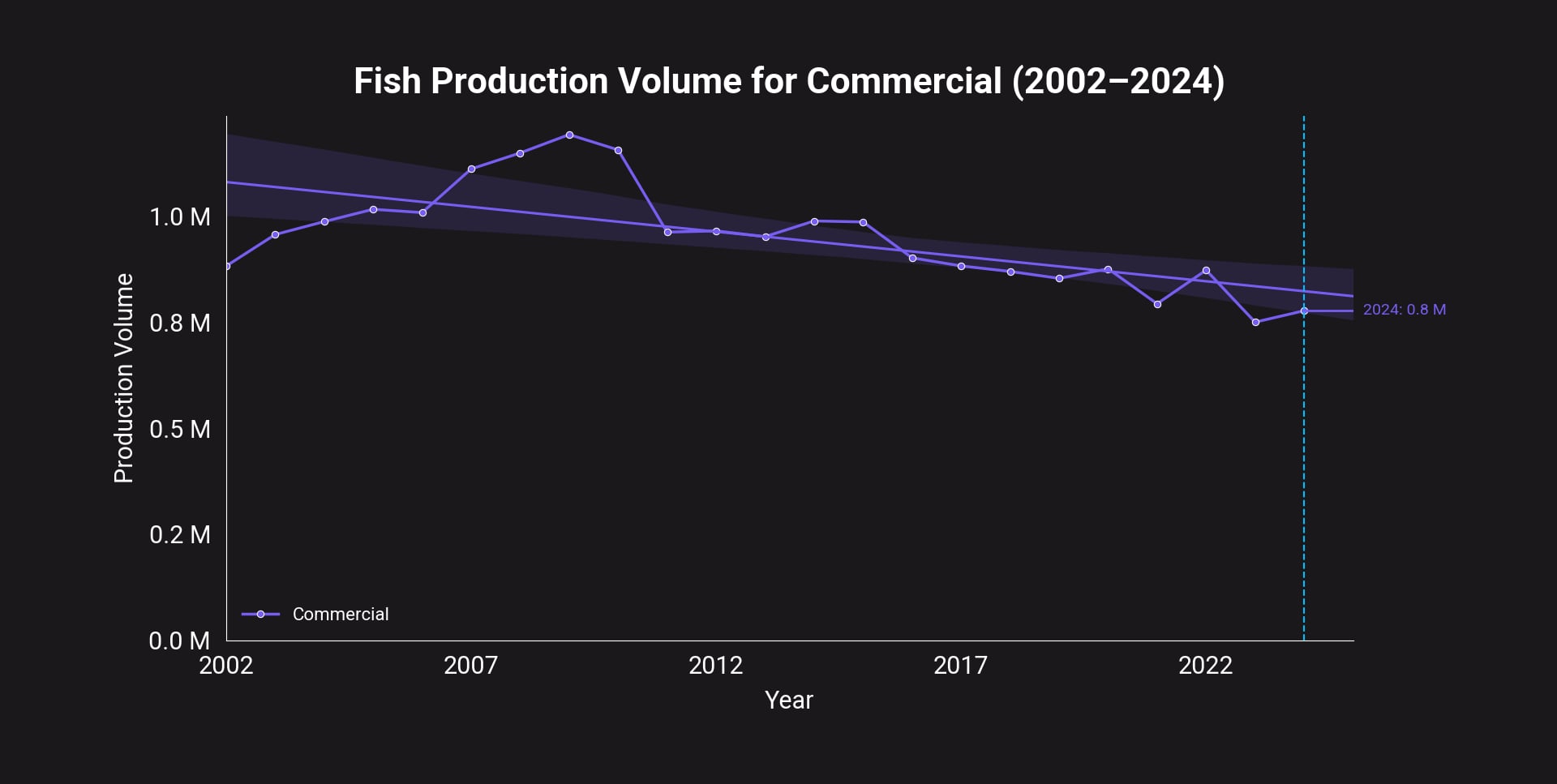
Commercial Fisheries: Slope: -65.7368, p-value: 0.0021, Std Err: 21.3494
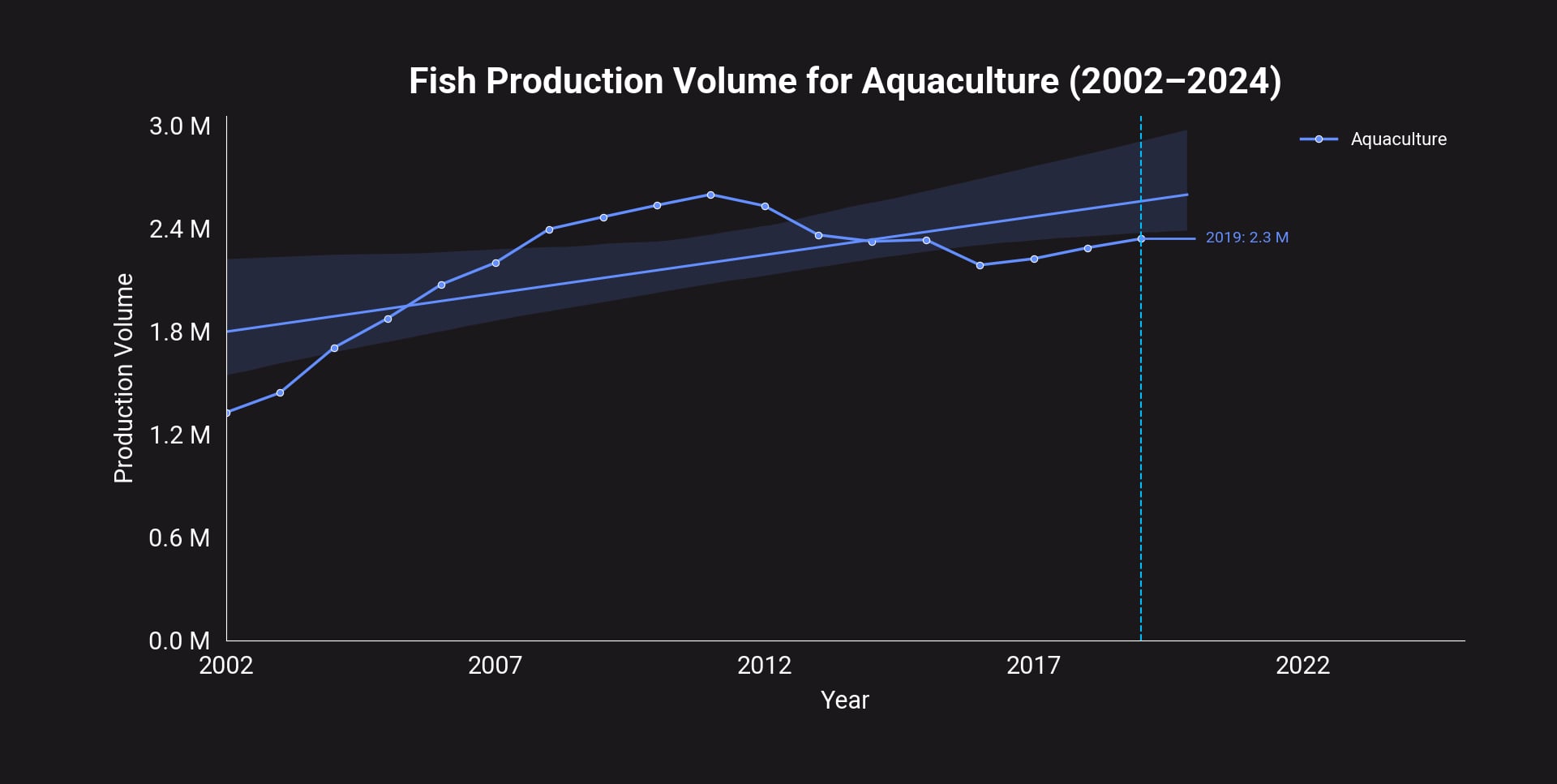
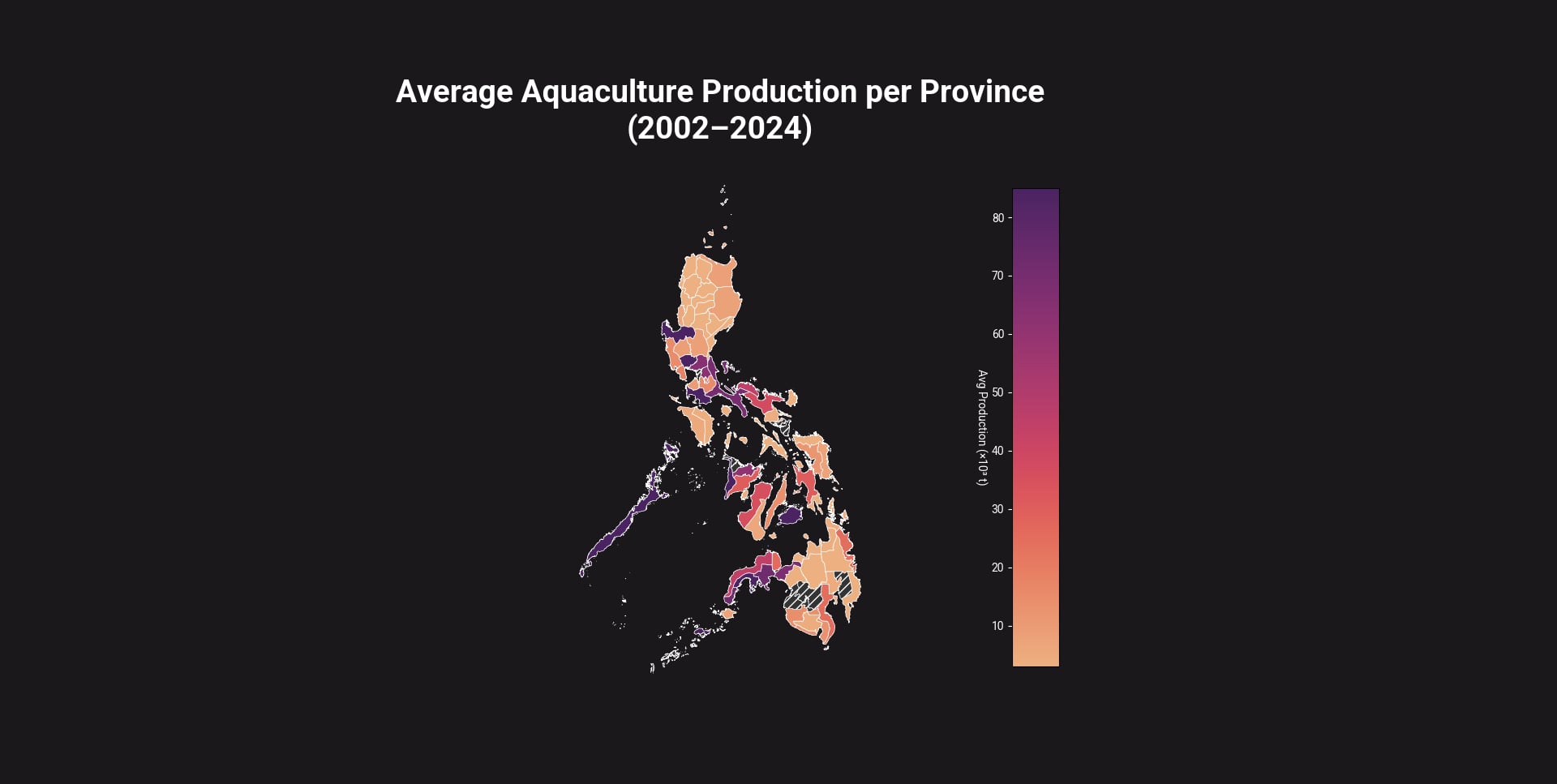
Aquaculture: Slope: 70.6809, p-value: 0.00197, Std Err: 22.8399
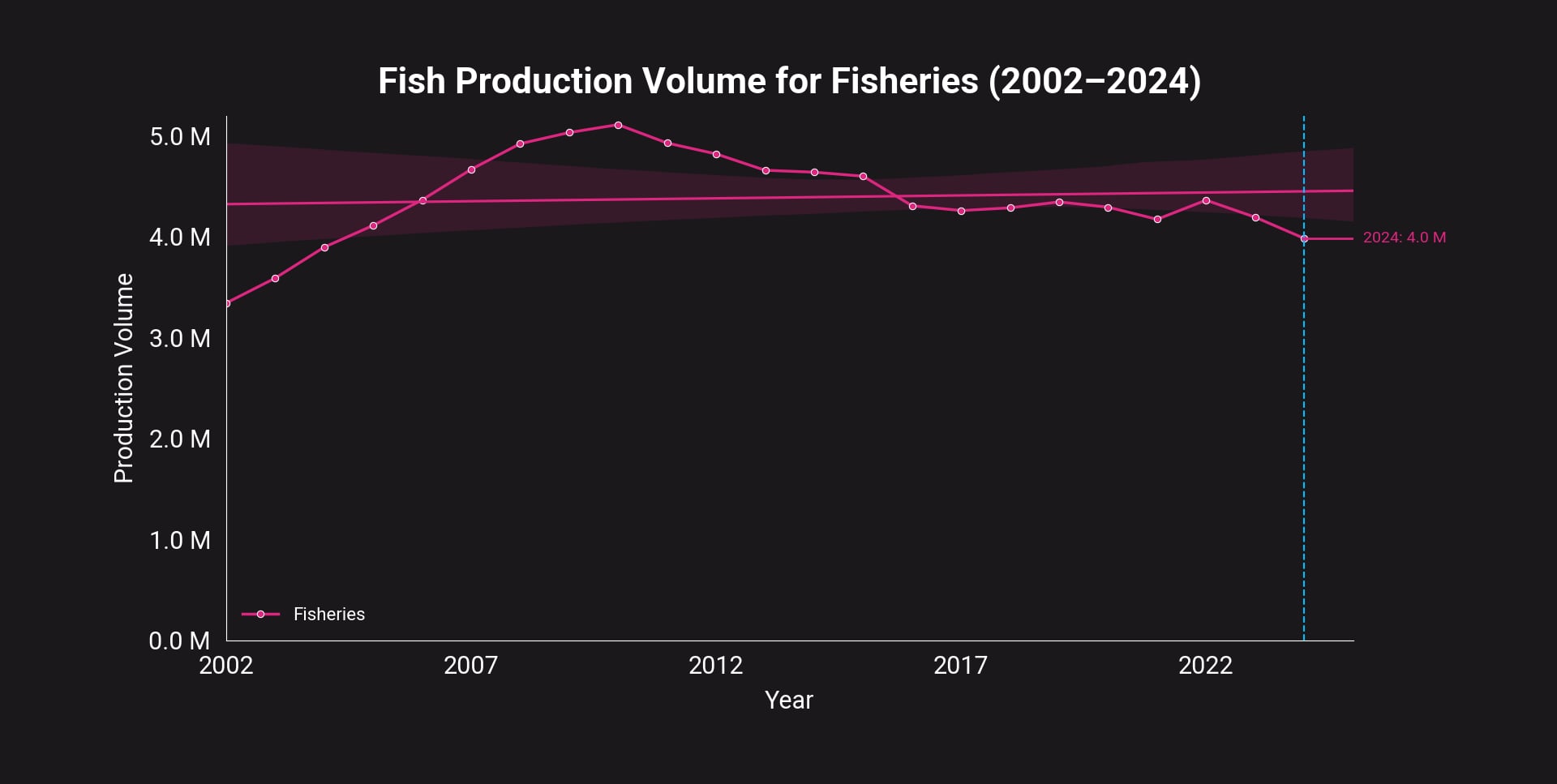
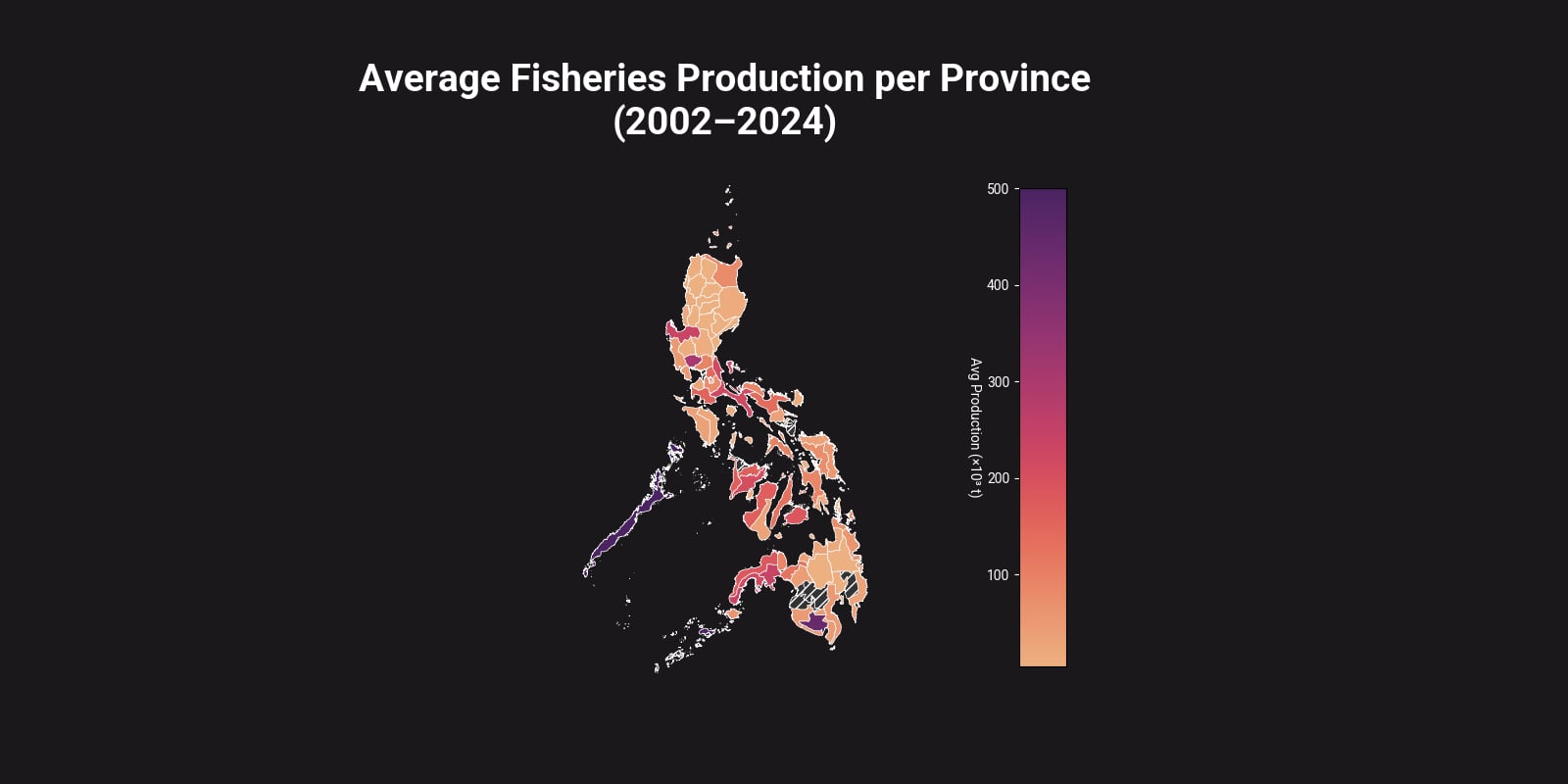
Fisheries: Slope: 2.3524, p-value: 0.9581, Std Err: 44.8246
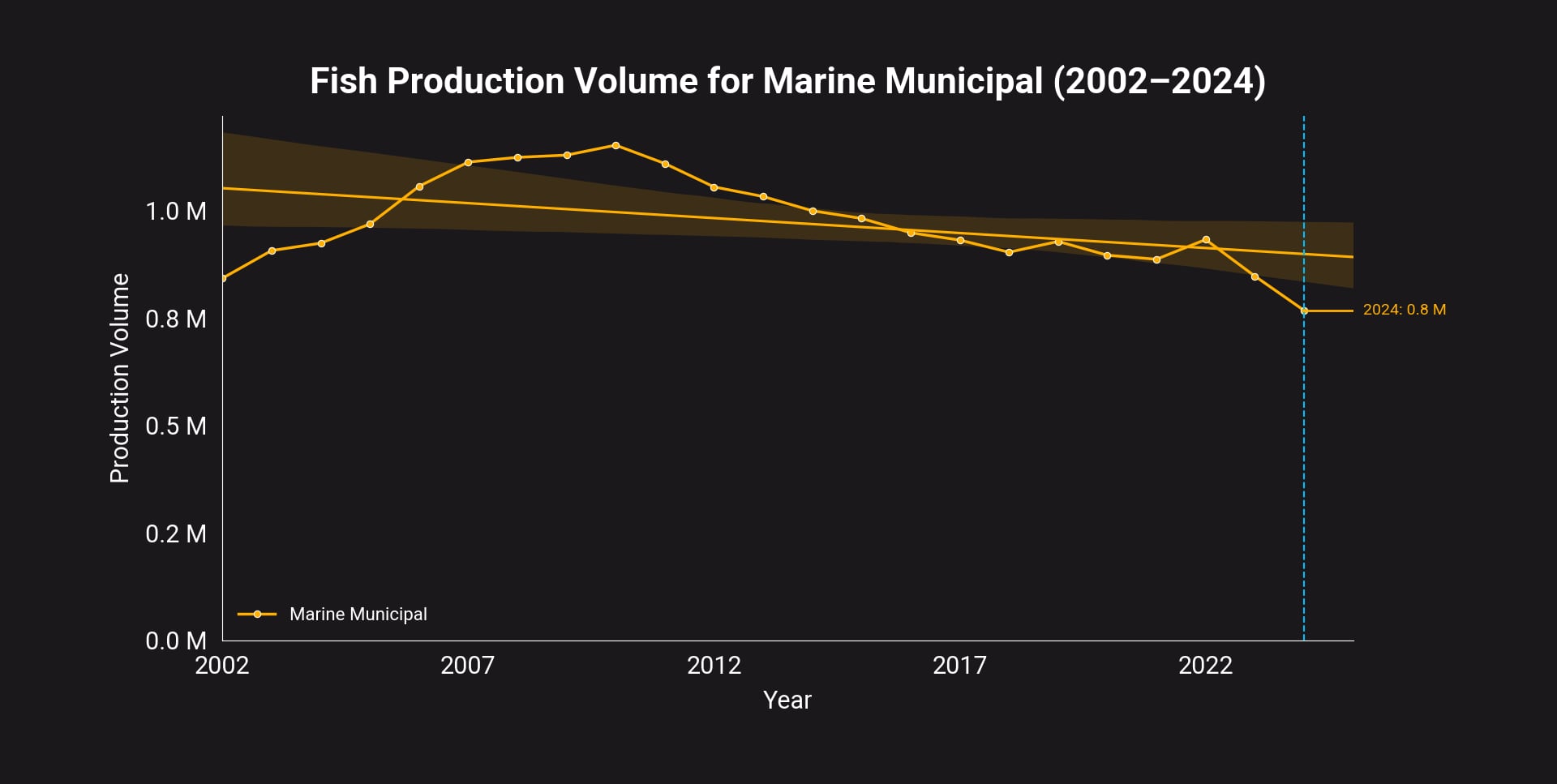
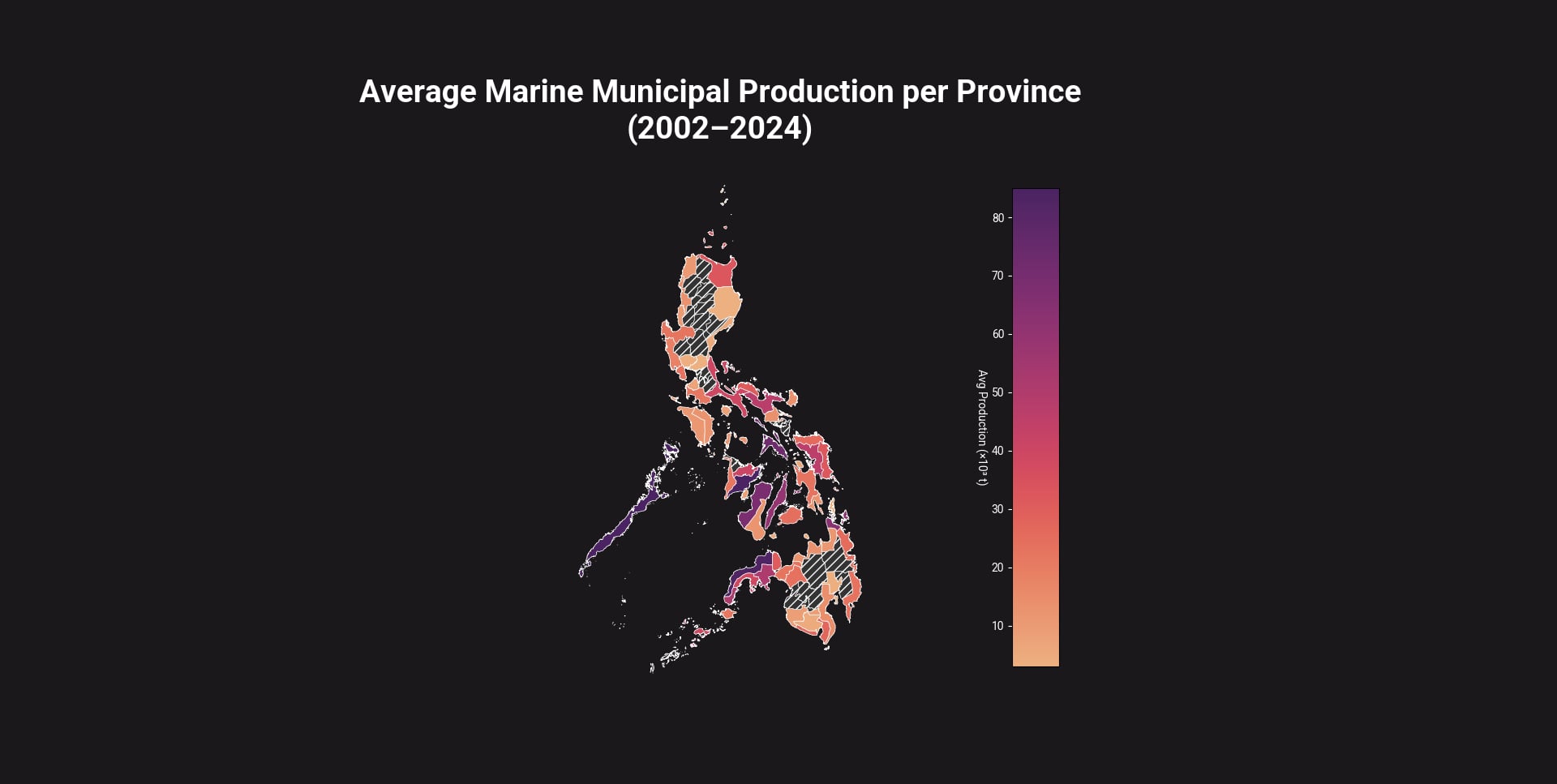
Marine Municipal Fisheries: Slope: -30.0321, p-value: 0.0043, Std Err: 10.52
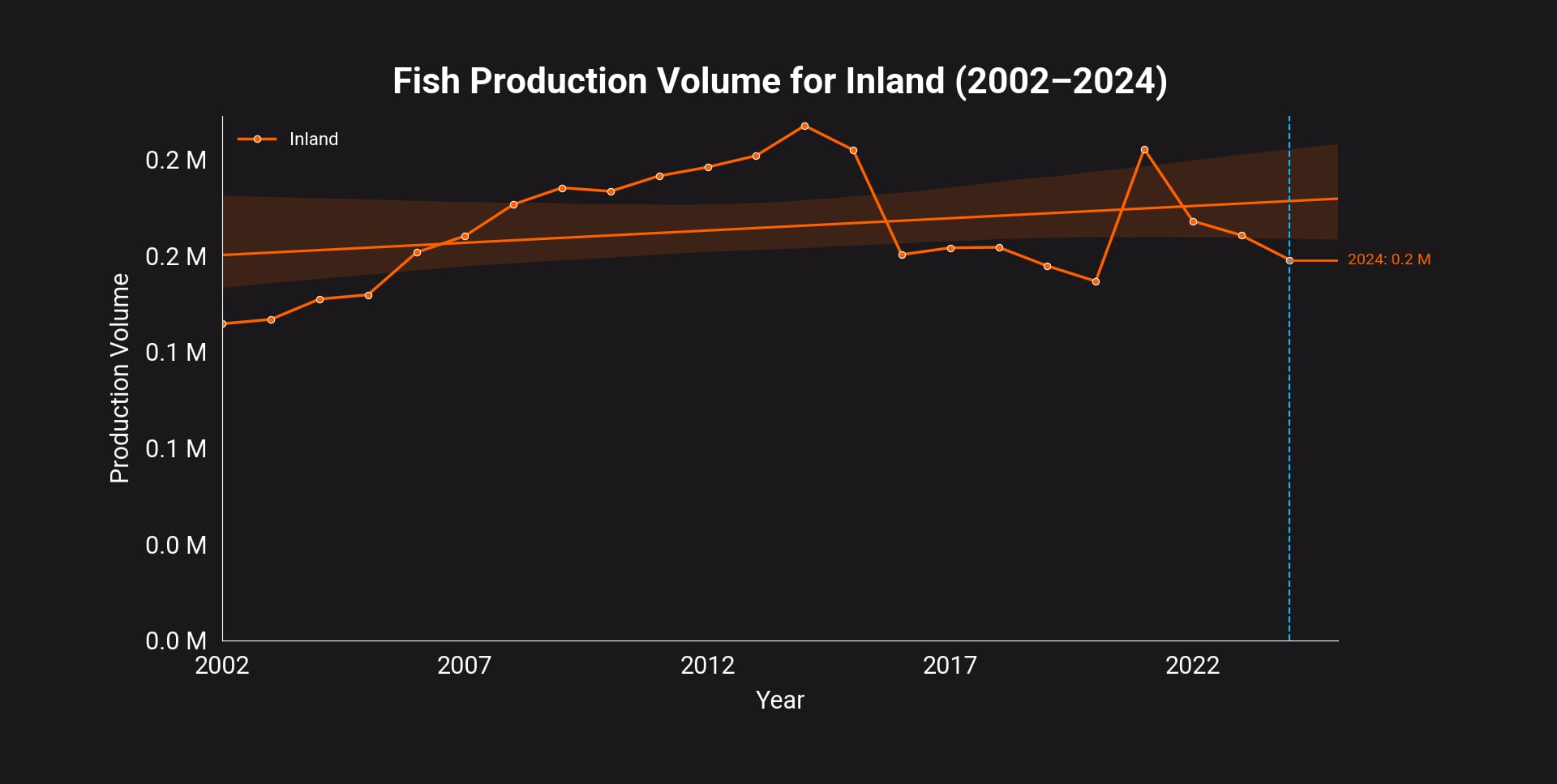
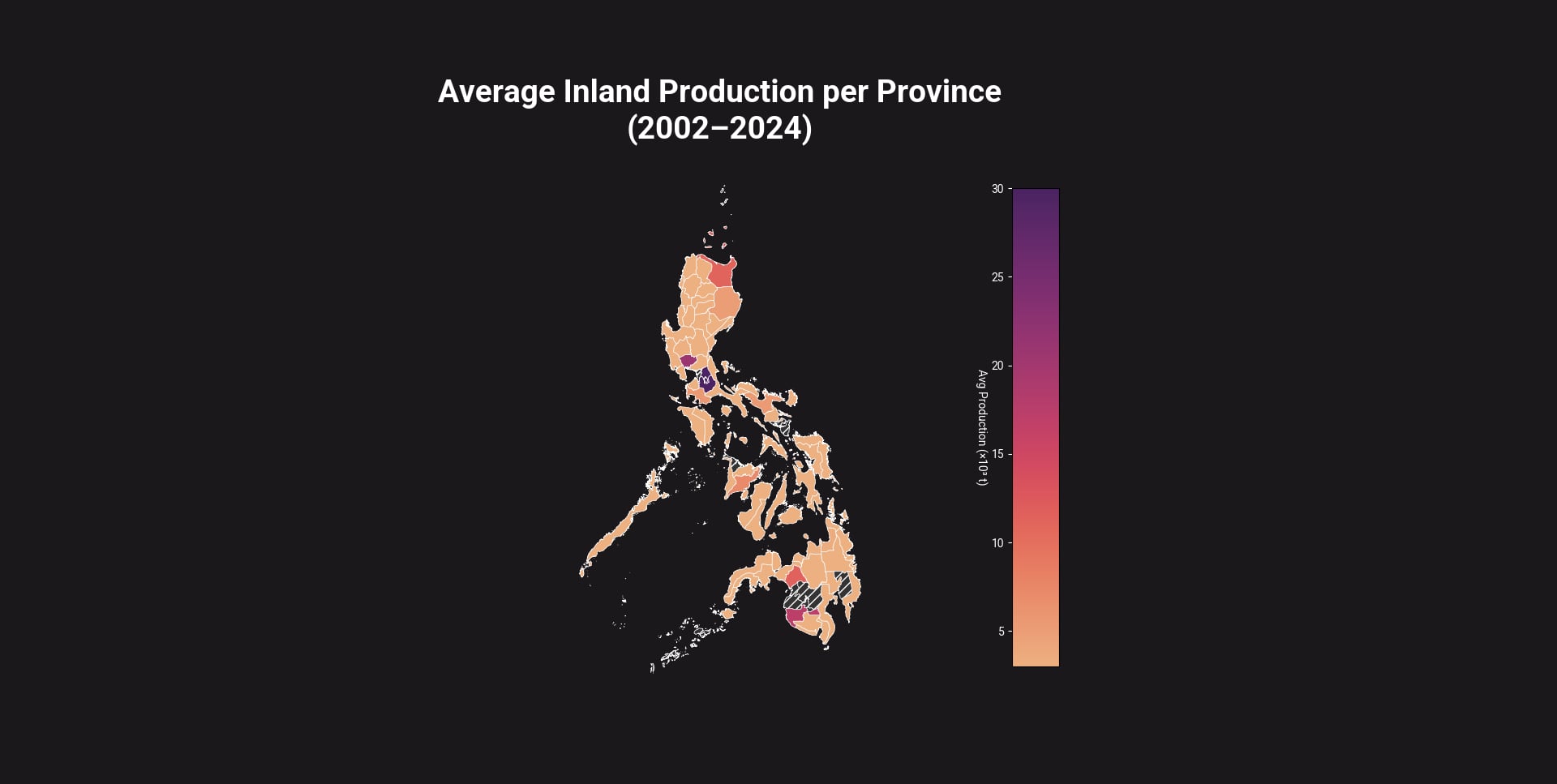
Inland Municipal Fisheries: Slope: 1.4145, p-value: 0.6760, Std Err: 3.3847
Overall Fish Production Trend Interpretation
The results show that there are trends in commercial, aquaculture, and marine municipal fisheries. Given the negative slope for the commercial and marine municipal fisheries, it shows that there is a negative trend in production for these sectors, while there is a positive trend in production for aquaculture
.The fisheries and inland municipal fisheries sectors do not show any significant trends, as indicated by their p-values being greater than 0.05. This suggests that the production in these sectors has remained relatively stable over the years and there is no trend in their production
Overall Fish Production per Region Geospatial Graph
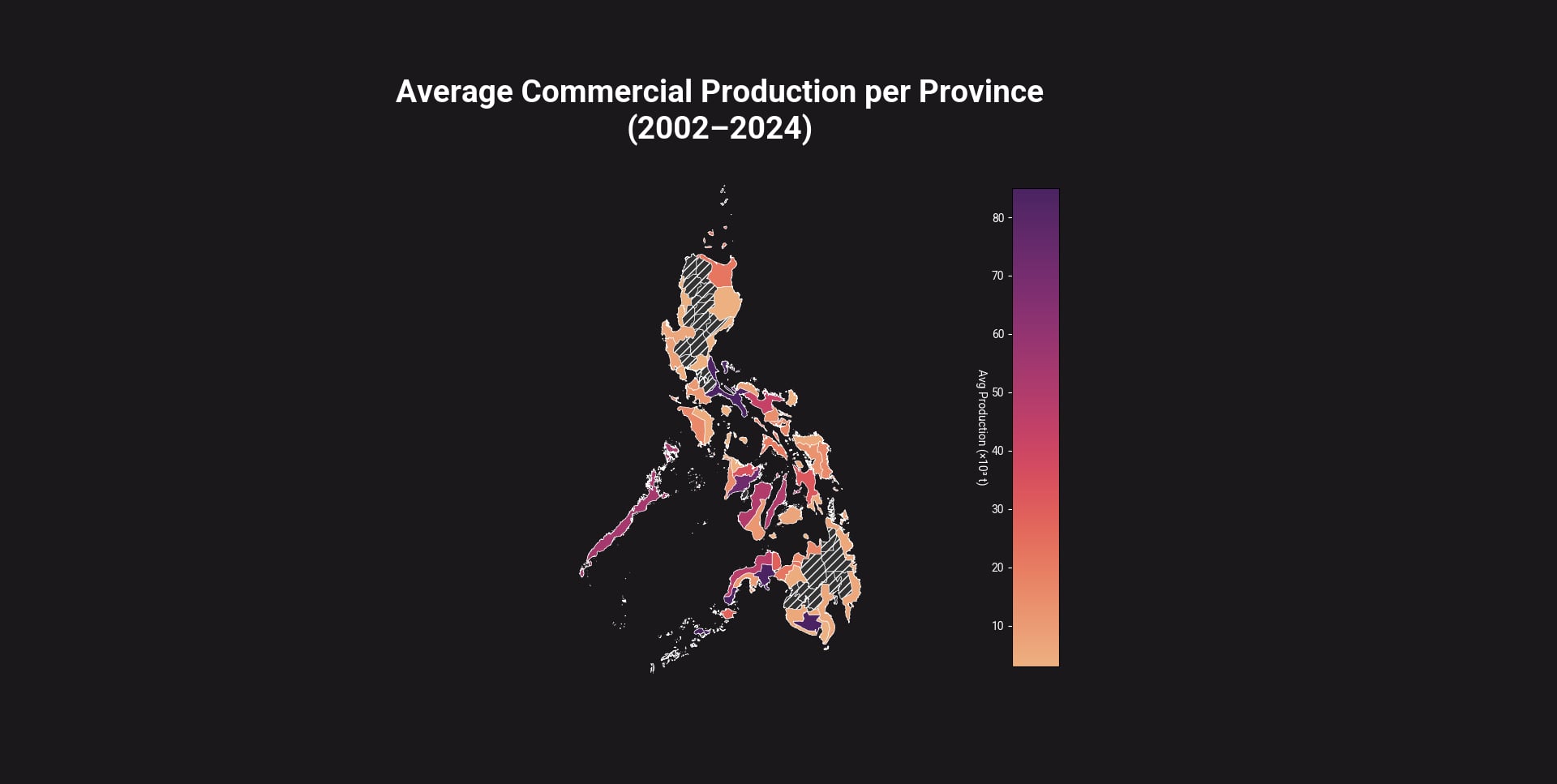
Commercial Fisheries:
Aquaculture:
Fisheries:
Marine Municipal Fisheries:
Inland Municipal Fisheries:
Overall Fish Production per Region
Top producers are coastal/island regions:
- ARMM (Autonomous Region in Muslim Mindanao): ~35.98 M (19.1% of national total)
- Region IX (Zamboanga Peninsula): ~25.32 M (13.4%)
- Region IV-B (MIMAROPA): ~24.18 M (12.8%)
- Region VI (Western Visayas): ~16.25 M (8.6%)
- Region IV-A (CALABARZON): ~14.49 M (7.7%)
Together these five regions account for ≈62% of all production, reflecting their extensive coastlines, rich fishing grounds, and well-developed aquaculture.
Mid-tier contributors: Regions XII (SOCCSKSARGEN), III (Central Luzon), V (Bicol), VII (Central Visayas), and VIII (Eastern Visayas) each contribute between 3.6% and 7.0% of the total, with Region XII owing 39.53% of their total in commercial fishing (highest percentage from commercial fishing) and the other mid-tier contributors also boasting increased percentages from municipal fishing.
Minimal contributors:
- CAR (Cordillera Administrative Region): 0.16 M (0.08%)
- Region II (Cagayan Valley): 2.33 M (1.2%)
- NCR (Metro Manila): 2.65 M (1.4%)
These regions lack significant marine access (CAR is entirely landlocked) or have undergone rapid urbanization (NCR), leaving little room for large-scale fisheries.
Interpretation
Concentration in the south and major island groups: Regions with extensive coastal waters (Mindanao, Visayas island groups, MIMAROPA) dominate fish output, both from marine capture fisheries and aquaculture.
Economic and infrastructural factors: The top regions have long-established fishing traditions, port facilities, and supportive aquaculture industries (pond culture, cages).
Resource and policy implications: Regions in the mid-tier contributors have room to increase their outputs, and thus could benefit from efforts on boosting production while also adopting sustainable practices to avoid overfishing further marine degradation. Landlocked areas will remain peripheral in fisheries unless inland aquaculture is significantly developed.
Equity and food-security angle: Given the heavy reliance on a handful of regions, diversifying production zones and improving infrastructure in underperforming coastal provinces could enhance resilience against localized shocks (e.g., typhoons, overfishing).

Dale Sealtiel Flores
I am a 2nd year BS CS student from UP Diliman. I am currently in the process of finding what field of computer science I want to get into. I have somewhat dabbled in web development and data science.

Aaron Jori Baclor
I'm a Computer Science sophomore at UP Diliman. These days, I'm focusing more on myself and paying attention to the things that genuinely make me happy. I enjoy working on personal improvement—whether that's through gaming, basketball, or going to the gym.
I'm still figuring out which direction I want to take in tech, but I'm taking my time learning and exploring what clicks. For now, I'm just trying to stay consistent and enjoy the process.

Sebastian Lucian Reyes
ヾ(^∇^) I am a 2nd year comsci student, cybersecurity nerd, and an ever-wayward adventurer. Yours truly is a gamer, language learner/linguistics nerd, martial artist, gym bro, pianist, ROTC/COCC graduate, biker, swimmer, weeb, romantic, guy na palaging naka-shades, introvert-turned-extrovert, philosophy nerd, armchair geopolitical analyst, budding spiritualist, fragrance collector, aura farmer, and so so so much more!